Ube is not taro (and the color can lie)
Ube (Dioscorea alata) is a true yam with deep purple flesh all the way through. Taro is a different plant: a starchy corm with white or pale lilac flesh speckled with purple fibers. Taro desserts are earthier and starchier, while ube is sweeter, with a flavor people compare to vanilla, pistachio and white chocolate. In some bakeries the two get mixed up on labels, so it is worth asking.
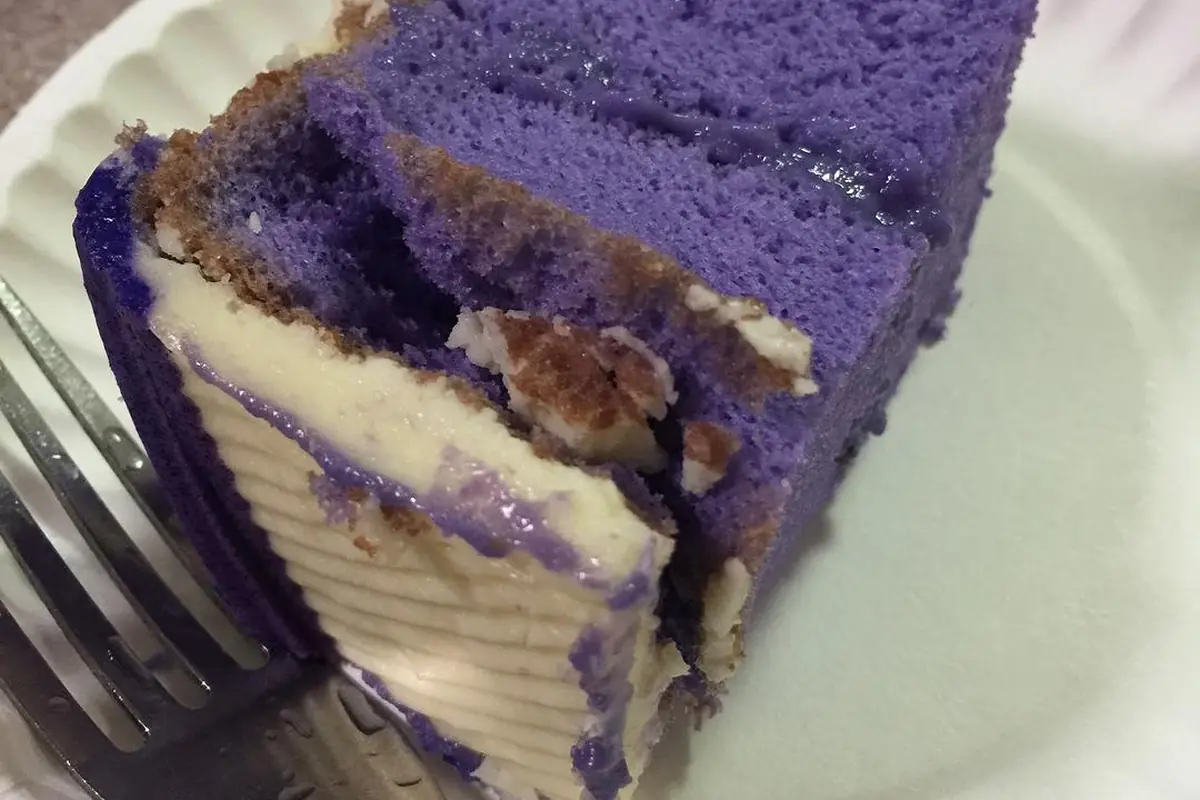
Color alone proves very little. Fresh ube is hard to find in the US, and most bakeries rely on frozen grated ube, ube powder, or concentrated ube extract, which is often tinted. A cake made with real ube or ube halaya tends to be a dusky, slightly grayish violet with a deeper flavor. An electric, uniform lavender with little taste usually means extract carried most of the load. Both can be pleasant; just know what you are paying for.
Halaya, chiffon and macapuno: how the classic cake is built
The standard Filipino ube cake is a chiffon: an oil-based sponge leavened with whipped egg whites, so it stays soft and moist even when chilled. Better versions fold ube halaya (also spelled haleya) into the batter. Halaya is grated purple yam slowly cooked with condensed milk, butter and sometimes coconut milk until it becomes a thick, glossy jam.
The frosting varies. Some bakeries use whipped cream, others a stable ube buttercream or a cream cheese frosting. Look for layers spread with halaya or with macapuno, sweet strands of a soft, jelly-like coconut mutant, a common and very good pairing. Leche flan on top turns it into an ube flan cake, sometimes called a custard cake, which is popular for celebrations.
Ordering a whole cake for a party
Slices and small rounds are often available on the shelf, but a full 8 or 10 inch cake usually needs one to three days of notice, and more around Christmas, New Year and graduation season, when Filipino bakeries are busiest. Expect roughly $35 to $70 for a standard whole cake, and more for tiered or decorated cakes. Ube roll cakes are cheaper and travel well.
Because chiffon and whipped cream are delicate, keep the cake refrigerated and bring it out about 20 minutes before serving so the sponge softens and the flavor opens up. It keeps three to four days in the fridge in a covered box.
Where ube shows up beyond the cake case
Filipino bakeries treat ube as a flavor family rather than a single dessert. The same halaya that fills a chiffon turns up in ensaymada, pandesal, crinkle cookies, hopia and the purple scoop of ice cream on top of halo-halo. If a bakery makes its own halaya, it is often sold by the jar, which is a good sign that the cakes are built on the real thing. Ask for a taste of the jam before committing to a whole cake.