Croissants Near Me

A real croissant takes two or three days from mixing to the oven, which is why the good ones are worth seeking out. The bakeries listed here bake them in-house; below is a short course in what you're paying for and how to pick a winner from the case.

10,998 places 51 states Also searched as: fresh croissants near me, butter croissant near me, french bakery croissants
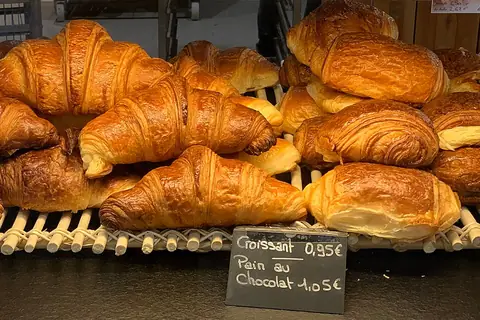
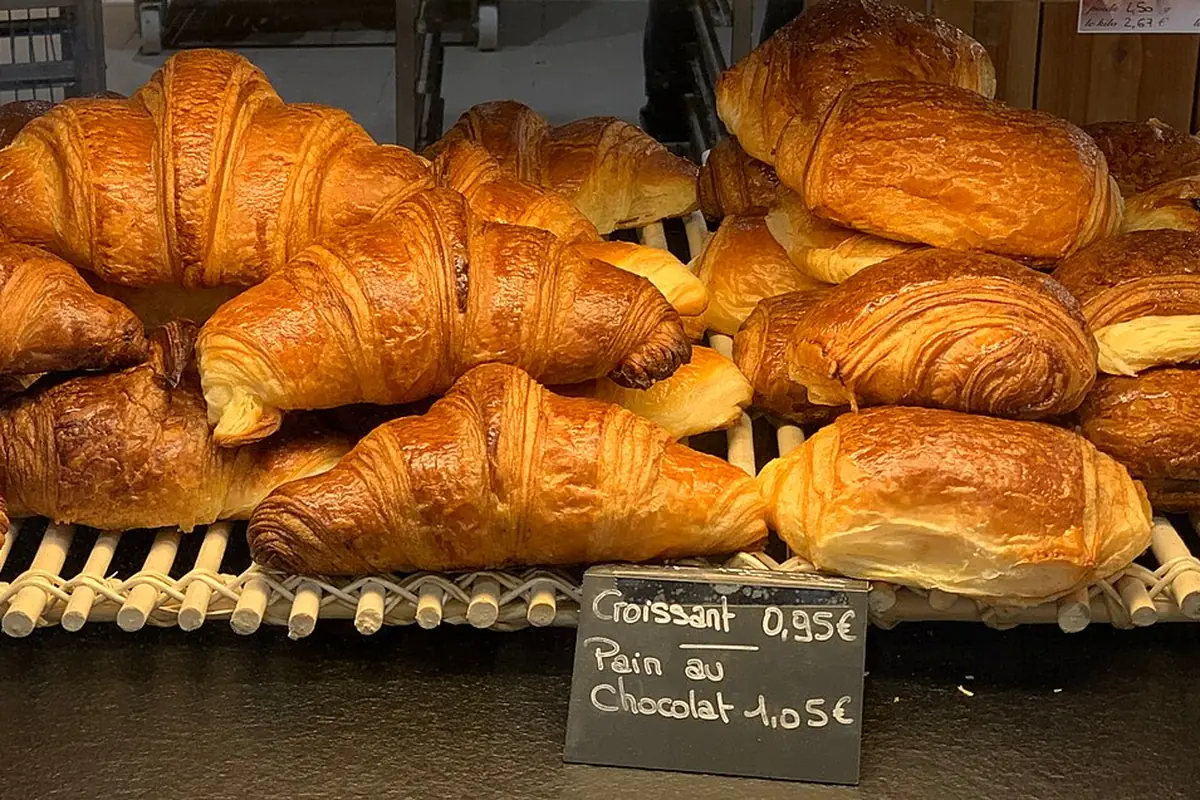
Boulangerie Bardoulet (Contrevoz) - croissants et pains au chocolat

Croissants closest to you

Share your location once and we will sort bakeries from closest to farthest, with the distance to each.

Layers you can count

Croissant dough is a lightly sweetened yeast dough wrapped around a flat slab of cold butter, then rolled out and folded, chilled, and rolled and folded again. Each fold multiplies the alternating sheets of dough and butter. In the oven, water in the butter turns to steam and pushes the sheets apart while the yeast lifts the whole thing, producing the honeycomb interior you see when you cut one in half.

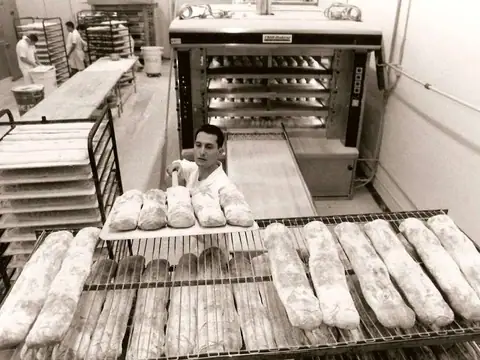
It's fussy work. If the kitchen is too warm, the butter melts into the dough and the layers blur; if the butter is too cold, it shatters into patches. Bakeries that make croissants from scratch usually mix one day, laminate and shape the next, and bake early in the morning. Some shops bake frozen, pre-shaped dough from a supplier, which can be perfectly decent but rarely matches an in-house croissant.

What the case tells you

  • Color: deep golden brown with darker tips. Pale croissants are underbaked and taste of raw flour.
  • Cross-section: open, irregular holes with thin walls. A tight, cottony crumb means the layers merged.
  • Weight: light in the hand for its size. Heaviness signals dense dough or too little proofing.
  • Shine: a glossy egg-wash finish without grease spots on the paper beneath.
  • Shape: in many French bakeries, a straight croissant traditionally signals all butter, while a curved crescent marks the cheaper ordinaire. American bakeries don't follow that rule, so ask.

From Vienna to the morning pastry case

The croissant's ancestor is the Austrian kipferl, a crescent-shaped roll that was around long before laminated dough. Viennese-style baking became fashionable in Paris during the 19th century, and French bakers eventually applied puff-pastry layering to a yeasted dough. By the early 20th century the croissant as we know it was a fixture of French breakfast, and the broader family of butter-rich breakfast pastries is still called viennoiserie in honor of that Austrian influence. Most of the colorful stories about bakers and sieges are legends rather than documented history.

Timing, price and what to do with leftovers

Croissants are at their best within about four hours of baking, so mornings are the time to buy. Popular bakeries often sell out of plain croissants by late morning on weekends. Plain all-butter croissants at independent bakeries typically run $3 to $5.50, with ham-and-cheese or filled versions higher. Supermarket croissants are cheaper but usually made with a mix of fats and baked from frozen.

Leftovers keep a day in a paper bag. Reheat at 350°F for a few minutes to bring the crust back. Day-old croissants also make excellent bread pudding, breakfast sandwiches and French toast, and bakeries turn their own extras into almond croissants for exactly this reason.

Styles and flavors to look for

Tips before you go

  • Shop before 10 a.m. for the best selection; croissants are a morning pastry.
  • Ask whether croissants are laminated in-house or baked from frozen dough.
  • Never refrigerate croissants; store them in paper at room temperature or freeze them sealed.
  • Reheat in an oven or toaster oven for three to five minutes, not in a microwave.

Croissants bakeries by state

StatePlacesCities with the most
California1,525Los Angeles, San Francisco, San Diego
New York1,013New York, Brooklyn, Flushing
Texas763Houston, Dallas, Austin
Florida759Miami, Orlando, Delray Beach
Illinois427Chicago, Schaumburg, Naperville
Pennsylvania414Philadelphia, Pittsburgh, Lancaster
New Jersey408Jersey City, Fort Lee, Red Bank
Ohio345Cincinnati, Columbus, Dayton
Massachusetts339Brookline, Cambridge, Boston
Virginia305Alexandria, Norfolk, Arlington
Georgia292Atlanta, Alpharetta, Marietta
Michigan282Detroit, Ann Arbor, Birmingham
North Carolina273Charlotte, Raleigh, Durham
Washington265Seattle, Redmond, Bellevue
Colorado235Colorado Springs, Denver, Aurora
Arizona207Phoenix, Tucson, Scottsdale
Missouri200St Louis, Kansas City
Maryland194Bethesda, Baltimore, Rockville
Oregon185Portland, Beaverton
Wisconsin174Madison, Milwaukee
Minnesota173St Paul, Minneapolis, Saint Paul
Indiana163Indianapolis, Kokomo
Tennessee162Nashville, Memphis
South Carolina144North Charleston, Greenville, Myrtle Beach
Connecticut134West Hartford, Fairfield, Stamford
Utah128Salt Lake City, St George
Louisiana124Lafayette, New Orleans, Metairie
Kentucky106Louisville
Oklahoma103—
Nevada91Las Vegas, Henderson
Alabama83Huntsville
Kansas79Wichita
New Hampshire74—
Hawaii68Honolulu
Arkansas67Little Rock, Conway
Mississippi66—
Iowa63—
Maine62—
District of Columbia61Washington
Idaho55—
New Mexico53Albuquerque, Santa Fe
Nebraska52Omaha
Montana50—
Vermont43—
West Virginia40—
Rhode Island37—
Delaware26—
Alaska24Anchorage
South Dakota23—
Wyoming22—
North Dakota17—

Questions people ask

Why are bakery croissants expensive?
They take two to three days of mixing, laminating, chilling and proofing, and they use a lot of butter. Most of the cost is skilled labor and time.
How long do croissants stay fresh?
They are best within a few hours of baking and acceptable the next day after a short reheat. Frozen, they keep for about a month.
Are croissants French or Austrian?
Both, in a way. The crescent shape comes from the Austrian kipferl, while the laminated yeast dough was perfected by French bakers in the late 19th and early 20th centuries.
Does a straight croissant mean it's made with butter?
In many French bakeries, yes, by tradition. In the US the shape is just a style choice, so ask the bakery.