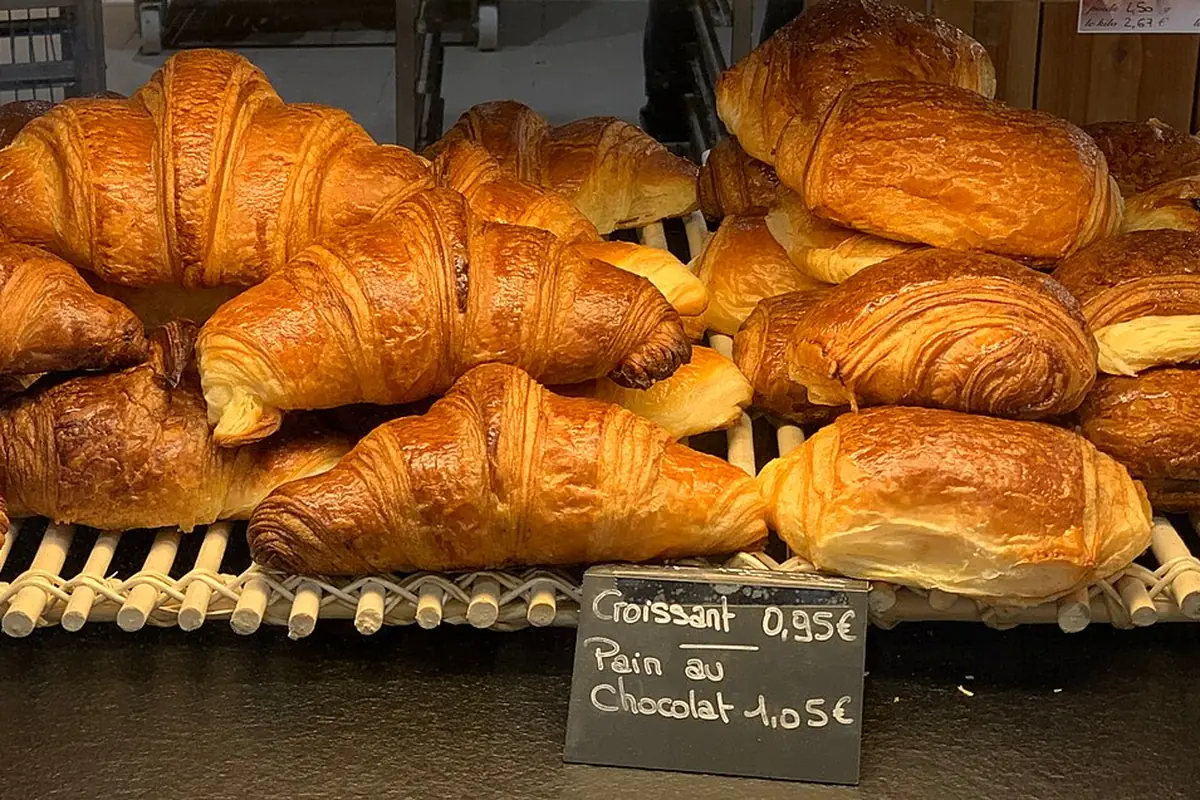
A second life for yesterday's croissants
Fresh croissants are too delicate and full of moisture for this treatment, so French bakers traditionally used the unsold ones from the day before. The croissant is split, brushed or dipped in a light sugar syrup (often flavored with rum, orange blossom or vanilla), filled with almond cream, spread with more on top, scattered with sliced almonds and baked a second time. It finishes under a snowfall of powdered sugar.
The result is crisp and toasty outside, custardy and dense inside, a completely different pastry from the one it started as. Because it relies on leftovers, some bakeries make almond croissants only in limited numbers, and they may run out earlier than you'd expect. Others now laminate dough specifically for them, which is a good sign of how popular they have become.
Almond cream versus frangipane
The two terms get used interchangeably on American menus, but pastry cooks draw a line:
- Almond cream (crème d'amande) is butter, sugar, eggs and finely ground almonds beaten together. It bakes up rich and slightly cakey.
- Frangipane is almond cream lightened with pastry cream, giving a softer, more custard-like filling.
Either works. What matters is that the filling tastes of toasted almonds rather than just sugar or almond extract. A strong bitter-almond perfume usually comes from extract; a gentler, nutty flavor comes from the nuts themselves.
Signs of a well-made one
Look for a deep golden top with toasted, not burnt, almond slices and a layer of filling visible at the seam. Lift it: it should be heavier than a plain croissant, but it shouldn't leave a puddle of syrup or grease on the paper. Cut into it and you want distinct flaky edges around a moist center. Two common faults are a soggy croissant that was over-soaked and turned to pulp, and a dry one where the syrup step was skipped and the almond cream sits on top like a crust.
Sweetness is the other test. The powdered sugar on top adds a lot, so a balanced almond croissant keeps the syrup and filling restrained. If your teeth ache after two bites, try a different bakery.
Price, timing and storage
Almond croissants usually cost a dollar or two more than plain ones, roughly $4.50 to $7 at independent bakeries. Because they are made from the previous day's croissants, they often come out later in the morning than the first plain batch. Unlike plain croissants, they hold up fairly well: they keep a day or two in a closed container, and a few minutes in a 325°F oven crisps them again. They freeze well too.